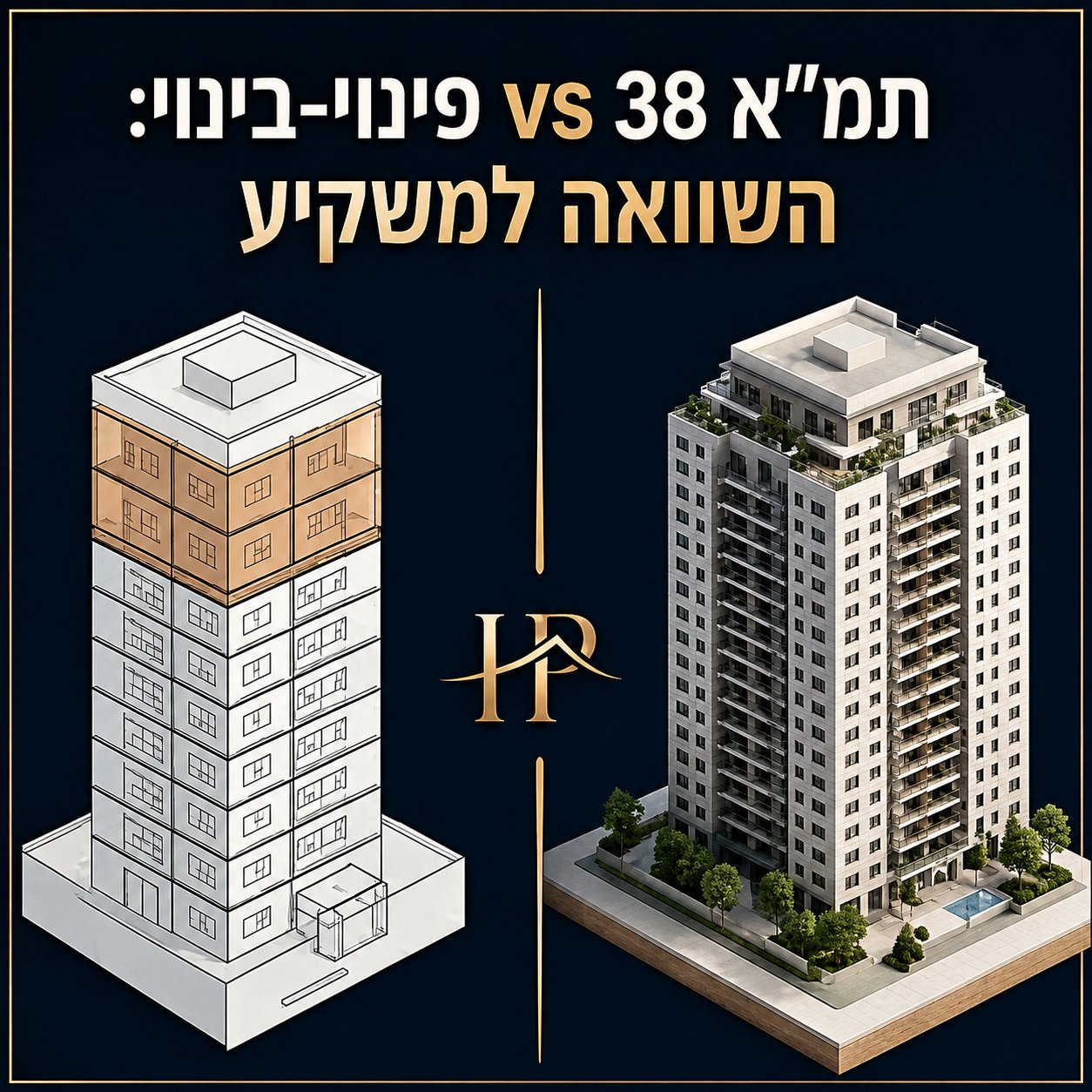
Two Paths to Urban Renewal
Urban renewal has become one of the main engines of the Israeli real-estate market, and its two best-known tracks are TAMA 38 and Pinui-Binui (evacuation-reconstruction). Both promise the owner of an aging apartment a new, upgraded asset, but they differ fundamentally in scope, complexity, timelines and their risk-return profile. Understanding these differences is essential for any owner or investor considering such a deal.
TAMA 38 — Reinforcement and Extension
TAMA 38 deals with reinforcing existing buildings against earthquakes. In the common model, a developer strengthens the existing building, adds floors and new apartments that it sells, and in return the residents receive an upgrade to their homes: a safe room, a balcony, an elevator and sometimes an extension. This is typically a single-building project of relatively limited scope.
- Shorter timelines, usually, compared with evacuation-reconstruction.
- A smaller number of owners, making agreement easier to reach.
- Residents usually stay in their apartments or move out for a relatively short period.
- More limited value creation, since it is an upgrade rather than rebuilding from scratch.
Pinui-Binui — Demolition and Rebuilding
Evacuation-reconstruction is a large-scale process: an entire complex of old buildings is demolished, residents are moved to alternative housing, and a new and much larger project is built in their place. Residents receive a newer, more spacious apartment, and sometimes more than one. Because of the scale, this is a long and complex process, involving hundreds of apartment owners, extensive planning approvals and many feasibility stages.
The essential difference is not only the size of the project, but the balance between value-creation potential and the complexity and time required to realize it.
What to Weigh as an Investor or Owner
The choice between the tracks depends on the property itself, its surroundings and the profile of the rights holder. Evacuation-reconstruction generally offers higher value-creation potential, but involves a long horizon, greater planning uncertainty and dependence on the agreement of many owners. TAMA 38 offers a faster, more certain process, but with more modest value creation.
Additional factors worth examining include the developer's financial strength, the guarantee and security mechanisms, the planning status of the complex and the degree of agreement among residents. These deals span years, so the developer's soundness is critical. It is advisable to approach every deal with integrated guidance, both financial and legal, that reviews the contract and the feasibility. Every property and every rights holder is unique, so it is important to obtain individual advice tailored to the specific circumstances.